
The Academic Pillar
Building Discipline For Life
St. Pius X School believes all children can learn. Teachers strive to meet the varied needs of students by helping them to think critically and by designing instruction that embraces 21st century skills. St. Pius X utilizes a framework from our Diocese, state standards, and high school requirements to design a cohesive curriculum for students in kindergarten through grade eight. Our curriculum is sequential and strong. It helps students to be prepared for high school and beyond.
Kindergarten
- Students build a relationship with Christ through the sacraments, a faith-infused curriculum, daily prayer, the Theology of the Body program, and interactive prayer services.
- Students are exposed to a Science of Reading approach within a reading series. This approach utilizes phonemic awareness, phonics, language, and vocabulary to build a strong foundation for reading. We also utilize Orton-Gillingham’s multisensory techniques to facilitate students’ learning.
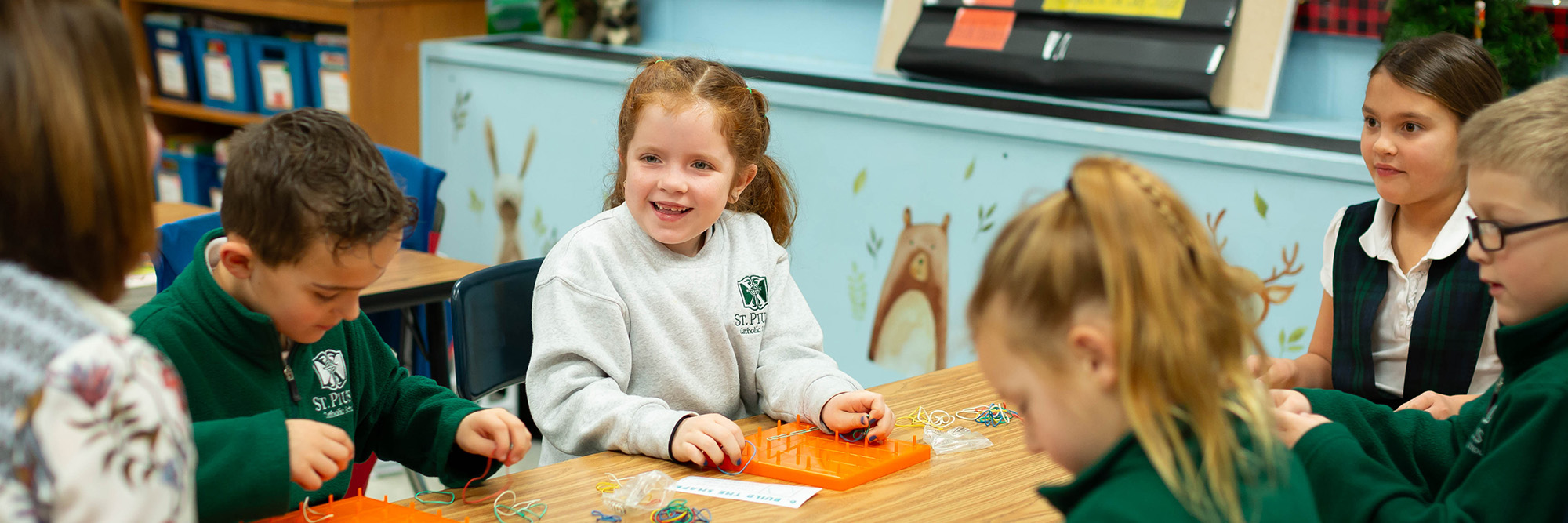
- Our comprehensive math curriculum uses research-based, real world applications through engaging manipulatives and hands-on activities.
- Kindergarten students are introduced to the study of history and social sciences. Concepts are anchored in student’s life experiences.
- Kindergarten students develop a sense of wonder and exploration through the application of the 5E science approach. These phases include, Engage, Explore, Explain, Elaborate, and Evaluate.
Primary Grades K-4
- Students build a relationship with Christ through the sacraments, a faith-infused curriculum, daily prayer, the Theology of the Body program, and interactive prayer services.
- Trained Orton-Gillingham teachers in grades K-4 teach a multi-sensory reading program that is aligned with the Science of Reading philosophy. All students are immersed in rich texts regardless of individual reading levels. Students practice reading and deconstructing texts through annotations.
- Grammar and writing are progressively taught in kindergarten through fourth grade. Easy Grammar, Institute for English and Writing (IEW), and Daily Oral Language are the platforms used to teach grammar and writing. Students are exposed to poetry and short stories then create key word outlines to construct writing samples.
- Grades K-4 differentiate math instruction with a cohesive grouping of lessons, detailed instruction, and guided and independent practice.Teachers explicitly teach and model concepts then allow students to extend their understanding through immersion with manipulatives and practice.
- We use HMH Science Dimensions to effectively address the Next Generation Science Standards (NGSS). Students learn science by utilizing the 5E inquiry-based instructional model. These are simply the five steps of exploration: engage, explore, explain, elaborate, and evaluate.
- Students study the decisions of the past so they are equipped to confront today’s problems with a deeper awareness of the alternatives before them and the likely consequences of each. Responsible citizenship is presented through an interactive classroom filled with field trips, simulations, and inquiry-based projects.
- Primary teachers use Response to Intervention and a variety of assessments to differentiate students into flexible groupings.These allow teachers to remediate or extend students’ learning.
- Students in grades K-2 have access to chromebooks in instructional centers to complement the curriculum. Students in 3rd and 4th grades have access to individual chromebooks to access and enrich the curriculum.
Middle School
Students in the middle school grades apply the basic skills they have previously learned as the content areas become more in-depth. More emphasis is placed on the learner’s responsibility for himself or herself, spiritually, academically, and personally.
The transition years between primary and junior high include increased use of technology. Students in grades 4 have 1:1 use of Chromebooks. Additionally at this level, students begin switching classes. This occurs for three subjects in fourth grade, all subjects in fifth grade, and all subjects including switching for leveled instruction in sixth grade. This allows more specialized instruction in the subject area.
The goal of the St. Pius middle school curriculum is to prepare all students for success in junior high.
Literature:
Fifth and sixth-grade students strengthen established reading habits by focusing on accuracy and grade-level fluency that support comprehension. They are exposed to a variety of literary genres. Realistic and historical fiction textual instruction focuses on story elements.
Students identify and apply their understanding of literary devices and figurative language in their daily reading and written responses to literary text. Through informational text, students recognize text features and their role in enhancing reading comprehension. They determine what the text says both explicitly and inferentially. Analyzing and annotating texts are key tools in reading to learn. Students cite specific textual evidence and draw logical conclusions.
With all literary studies, word analysis remains essential. Through the combined knowledge of morphology, letter-sound relationships and patterns, and syllabication, students learn to confidently decode unfamiliar words and expressions. Through the Membean vocabulary program, students build their vocabulary base through routine, consistent word study, and analysis.
English:
Voyages in English, published by Loyola Press, provides the foundation for understanding the key elements of written expression and grammar. Components of the Voyages writing program include explicit instruction for organizing complex writing pieces. These include personal narratives, persuasive pieces, informational writing, creative writing, and book reports. Students are exposed to a range of writing prompts, audiences, and purposes. They understand and apply conventions of Standard English: capitalization, punctuation, spelling, and recognition of complete, coherent sentences. The writing process challenges young writers to work through an established practice of prewriting, drafting, revising, proofreading, editing, and publishing.
Math:
In fifth grade, students make connections between understanding the underlying concepts behind the mathematical algorithms. Prior knowledge of place value, multiplication, division, fractions, and decimals is accessed and applied to content. Students are exposed to measurement, geometry, and interpretation of graphs and data. Student learning is supported through the interactive notebook, the Simple Solutions spiral review program, Khan Academy, and IXL. Remediation and extension takes place in the classroom in the form of small groups.
In sixth grade, students are differentiated into leveled classes. The extension of the fifth grade curriculum continues. The accelerated class begins Pre-Algebra, a seventh grade curriculum. All students continue to use the interactive notebook, the Simple Solutions spiral review program, Khan Academy, and IXL.
Science:
In fifth and sixth grade science, students are challenged to increase their observations of the natural world and more deeply develop the ability to infer, draw conclusions, and problem solve. Students are challenged to actively participate in engaging, hands-on activities and lessons. In fifth grade, students study general science topics such as: matter, energy, systems, and the Earth and the impacts of human activities. Sixth grade students study life science topics such as: cells, heredity, diversity of living things, and how life on Earth changes over time (evolution). Both grades use the HMH Science Dimension series.
Social Studies:
In fifth-grade, students study American History from Native Americans to the American Revolution and the Civil War. There is an emphasis on geography. Students are immersed in maps, charts, and graphs as they apply information to events in history. Active learning is key to their understanding. They participate in a Family Heritage Project, scoots, and multiple classroom presentations and demonstrations. Interactive notebooks enhance their note-taking skills.
In sixth grade, students study Ancient World History. The acronym G.R.A.P.E.S is used to break down the main parts of ancient civilizations. Students view civilizations through geography, religion, achievements, politics, economy, and social structure. Students continue to expand their geographic knowledge by using maps, charts, and graphs as they relate to these ancient civilizations. They are actively involved in the learning process by participating in a Wax Museum, an Egyptian Museum, classroom station activities, and Greek and Roman project presentations. The interactive notebook is used for organization of content.
Religion:
In fifth and sixth-grade religion, students focus on a deeper understanding of the sacraments, develop a personal relationship with Christ, and encounter God in Sacred Scripture and Sacred Tradition. Throughout the week, students creatively explore different aspects of their faith through interactive and relatable experiences. Weekly scripture readings, Adoration, rosary, and class discussions allow students to connect the faith to their everyday lives.
Junior High
In junior high, we are committed to instilling virtues and developing the minds of our students with our Catholic faith as the foundation. Our focus is to promote the social, emotional, and intellectual growth of our students and to prepare them to be servant leaders, good citizens, and life-long learners. Our emphasis is to promote excellence in academics and morals. We strive for academic rigor and instruction that will help students be prepared to meet the demands of high school and beyond. Junior high instruction promotes critical thinking skills, analytical skills, collaboration/communication, and application to set students up for academic success in high school and beyond.
Literature:
The objectives of the seventh and eighth-grade literature classes are to gain an appreciation for a variety of types of literature and to study it on a deeper level. Students apply story elements and connect personally to the literature, study vocabulary systematically and critically, improve writing skills according to the MLA essay style of writing, and become independent learners in preparation for high school classes. This course uses the Sadlier Vocabulary series and a combination of an anthology (Prentice Hall Literature), novels, dramas, poems, and other literature to broaden the understanding and appreciation of literature and universal themes.
English:
In 7th and 8th grade, students work on improving their writing and grammar skills, as well as their public speaking and presentation skills. Students learn how to write academic essays that follow MLA guidelines and create various projects throughout the year. We follow the Voyages in English grammar and writing series which focuses on the parts of speech, sentence diagramming, and writing structure.
Math:
Students are challenged to be problem solvers throughout the leveled curricula. Seventh graders take either seventh-grade math (Big Ideas-Focal Points) or Pre-algebra (Prentice Hall). In the spring, they have the opportunity to test in Honors Algebra 1. This course is taken at a high school each morning during their eighth-grade year. Eighth graders take either eighth grade math (Big Ideas-Focal Point), Algebra 1 (Prentice Hall), or the high school Honors Algebra 1. They also have the opportunity to test in an accelerated math class during their freshman year.
Science:
In seventh and eighth grade science, students learn to think analytically and are challenged to learn new concepts. They are involved in hands-on labs and experiments while working collaboratively. In seventh grade, students study topics in Earth Science such as: air and water circulation, weather, climate, the rock cycle, and Earth’s plates and history. The steps of the scientific method as applied for the science fair project. Eighth grade students study physics topics such as: forces and motion, gravity, friction, electricity, magnetism, energy and energy transfer. They are exposed to chemistry. Both grades use books from the HMH Science Dimension series.
Social Studies:
In seventh grade, students extend their learning about the very beginnings of North American history and how the “new world” was discovered and developed. They continue their lessons chronologically throughout US/North American history. Eventually, they finish their learning with the Civil War.
The eighth-grade curriculum begins with the Reconstruction directly after the Civil War and continues chronologically covering all major events in US history up through the Cold War. Eighth graders also participate in the National History Day Project.
The goals for students in both grades are for them to become productive members of society who know our nation’s history, why decisions/current practices are made, and can make logical, critical decisions.
Religion:
Seventh-grade students use Spirit of Truth: Living as a Disciple of Christ to focus on human dignity and being made in the image of God. Students are taught to see the beauty and practical use of Sacred Scripture and to live the Sacraments in a way that brings a desire to be closer to Jesus. Class is centered around the practice of daily prayer and gratitude journaling to grow the fruits of the Holy Spirit.
Eighth-grade students continue to solidify the reality of our Catholic faith as they prepare for the Sacrament of Confirmation. Students explore the Catholic faith traditions through the Spirit of Truth text, the Bible, the Catechism of the Catholic Church, saints, and moral principles. There is an emphasis on the development of a personal relationship with God and understanding the Church’s role in guiding moral choices.
Academic Support
The academic practice most impactful to the success of St. Pius X School is the establishment of an Academic Support program. The Academic Support Team includes Director of Special Education, reading specialist, three resource teachers, school counselor, a Speech/Language professional (through the local public school district), and the Principal/Assistant Principal. The team meets weekly to review program effectiveness, individual student concerns, and testing information. The obvious need for the program surfaced as enrollment increased, and we became the largest Diocesan school. Our commitment to academic rigor, excellence, and support remained, and we realized that the Academic Support program would provide students with diagnosed learning disabilities with the resources they needed to learn and achieve.
- A certified special education teacher leads the Academic Support Team and manages all ALP’s. (Alternative Learning Plans)
- In grades K-4, our Reading specialist utilizes a tiered Response to Intervention (RtI) model to provide students with targeted instruction tailored to their specific learning needs. Our Reading Interventionist and K-5 teachers are trained in Orton Gillingham.
- Three academic resource teachers support students with ALPs in grades 5-8. All resource teachers co-teach with content area teachers and instruct small remediation groups. They teach executive functioning skills, oversee extended testing time, and read tests to students who qualify. They run Care and Connect, an after school program for students with ALP’s needing minimal support for academic success.
- A full-time counselor helps students in all grade levels. The counselor meets with individual students, holds small group sessions during lunch, and conducts classroom lessons. The counselor administers the Terrace Metrics (TM) SEL assessment to students in grade 5-8 twice yearly. The team believes social/emotional learning is essential for academic achievement.
STEM/Library/Media
Kindergarten through fourth grade students attend STEM and library classes weekly, and fifth through eighth-grade students attend bi-monthly. The STEM lab encourages endless imagination through experiments in science, the application of mathematical facts, the discovery of the practical uses of technology, and the use of engineering and architecture to promote the development of building, design, and problem-solving skills. The STEM curriculum exposes students to technology while learning to use Chromebooks and iPads. Coding, keyboarding, and presentation skills using Google Docs and Google Slides are taught. Engineering, math, and science experiments reinforce understanding of the scientific method and are supported by technology. Circuit boards, Keva Planks, and Ozobots allow students to develop higher-level thinking skills. All classes participate in Digital Citizenship, learning Internet safety and the importance of leaving a positive digital footprint.
The library curriculum introduces a variety of genres and author studies while developing listening and reading skills for lifelong reading. Puzzles, felt boards, games, and the Clevertouch are used to introduce the research process, for evaluating sources (hard copy and online), accessing databases, preventing plagiarism, and citing/quoting sources. MAP and Lexile scores are utilized for appropriate book selection. Many activities encourage a love of reading. These include: Birthday Book Club, the March Madness Book Tournament, BookBreaks that provide monthly online author visits, and the annual Book Fair.
Art
Kindergarten through eighth grade students attend art classes weekly. Students are educated in the basic components of art production, cultural arts, and art history. Kindergarten through third grade students are introduced to a variety of materials and techniques to extend their understanding of art. Foundational pieces are expanded using cultural arts to ground students’ explorations. They learn techniques such as X-ray drawing, Japanese brush painting, building with clay, and landscape painting. Grades four through eight focus on technical elements and art principles using a mixture of cultural arts and classical art history as the foundation for explorations. Examples include: pen and ink drawing, oil pastel in the style of Matisse, portraiture, and linoleum carving. Students display their artwork through art competitions and the school-wide Fine Arts Night.
Music
The music curriculum integrates art, dance, song, and instruments into the music curriculum. During weekly classes, students learn various performance and composition skills as well as different parts of music history. Through both Orff and Kodaly methodologies, students develop creativity, critical thinking, collaboration, communication, linear and intuitive intelligence, leadership, non-verbal expression of emotion, confidence and self-esteem, and cultural awareness.
Physical Education/Health/Nutrition
Kindergarten through eighth-grade students attend physical education classes weekly. A theme approach is used in kindergarten through third grade to help provide developmentally appropriate experiences. The students learn a multitude of motor skills, both fine and gross. The goal behind the theme approach is to help children gain enough skill and confidence to participate in activities for a lifetime. These students are also provided with the opportunity to participate in the morning On the Move club. This is a walking/running club held twice weekly prior to the start of the school day.
Students in grades four through eight participate in exceptional learning experiences that nurture, challenge, and inspire students to lead an active lifestyle. The students learn the skills and rules of the game that are needed to play the following sports: lacrosse, flag football, soccer, basketball, volleyball, floor hockey, physical fitness testing (Fitness gram), ultimate frisbee, ultimate golf, and dance. These activities are enhanced with lead-up games that develop the skill learned and build confidence and self-esteem.
Spanish
Third through eighth grade students attend Spanish class weekly. The comprehension- based curriculum focuses on Spanish language acquisition. The Teaching Proficiency through Reading and Storytelling program provides a variety of activities that engage different learning styles. There is also a strong cultural component included in the curriculum where students learn the practices and culture of Spanish-speaking countries.
Third and fourth grade students attend Spanish once weekly for forty minutes. The goal is to review basic vocabulary in context through greetings, colors, numbers, days of the week, and months of the year. Students are expected to create meaningful context within conversations, video stories, and songs. Fifth through eighth grade students attend Spanish twice weekly for 45 minutes. The goal is for students to develop their listening, reading, writing, and speaking skills. All students are exposed to various sources of information and Spanish resources that offer a comprehensive input approach, which provides students with multiple opportunities to acquire the language.